The Synodontis multipunctatus, commonly known as the Cuckoo Catfish or Cuckoo Synodontis, is a freshwater catfish endemic to Lake Tanganyika in East Africa, one of the oldest and deepest rift lakes in the world. It is found throughout the lake's rocky littoral zone, where it lives in large schools among rocks and sand at varying depths.
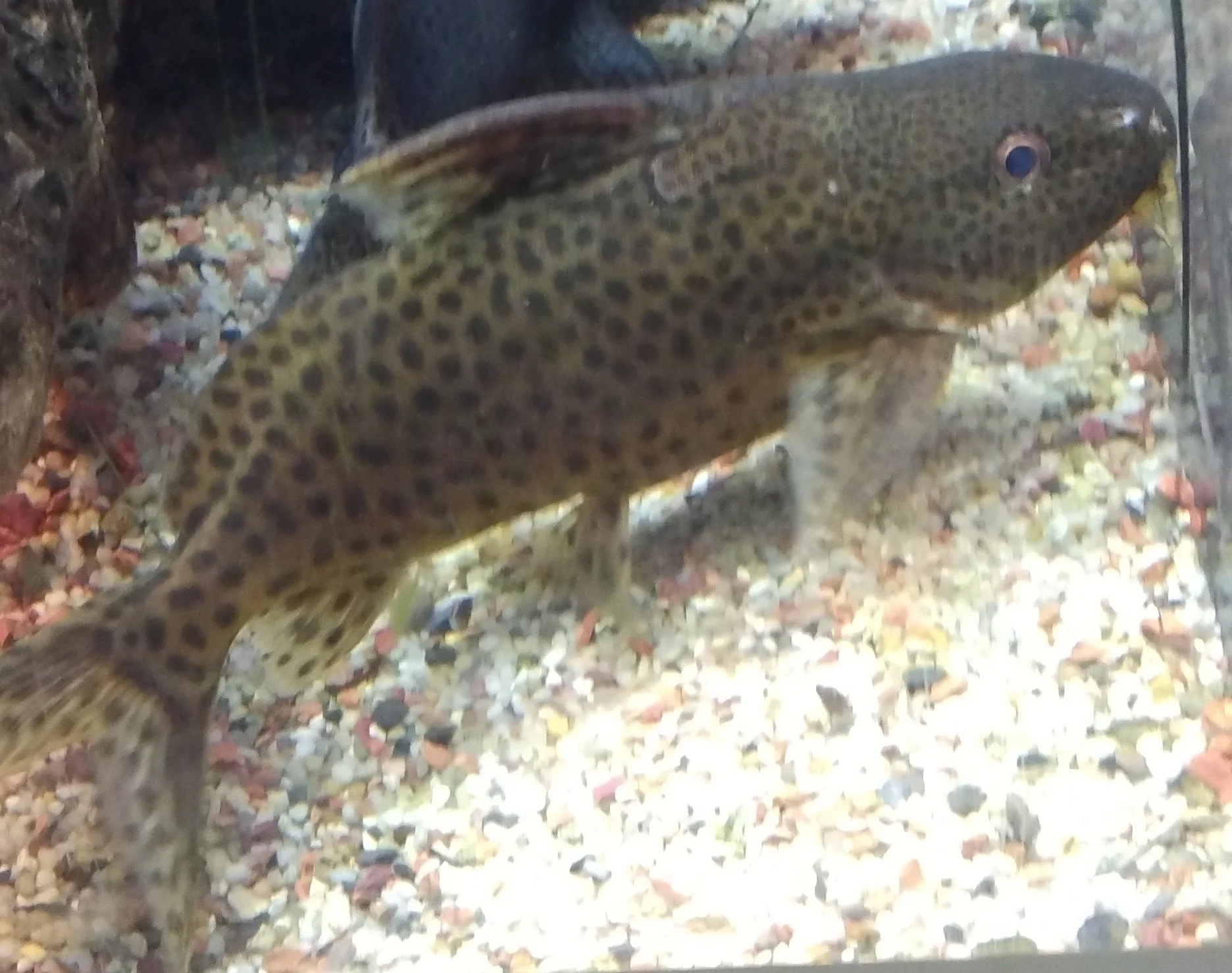
An elongated, fusiform catfish with a golden-beige to light-brown body covered in randomly scattered dark black blotches across the body and head. The underside is creamy white with no spots, and the caudal fin is forked with black stripes along each fork. The dorsal fin carries a black triangle with a white margin on the rear edge.
Three pairs of barbels surround the mouth, and the eyes are notably large — an adaptation to the dimmer depths at which it is often found. Colouration tends to darken and intensify with age. Growing to around 15 centimetres in the aquarium, with females reaching slightly larger sizes than males, it is one of the more active and visible Synodontis species.
A social, schooling fish that should be kept in groups of at least four or five. Single specimens tend to be secretive and hide constantly, whereas a group will be bolder and more active, particularly at dusk and during the night when the species is naturally most active. It is semi-aggressive, mainly towards its own kind, but group-housing diffuses this aggression. It occupies the mid to lower levels of the aquarium and needs hard, alkaline water that mirrors its native lake.
Provide a rocky aquascape with plenty of caves and hiding spots, open swimming lanes between rock piles, and strong filtration with good oxygenation.
Merits
The Cuckoo Catfish earns its common name from one of the most remarkable breeding strategies in the fish world — brood parasitism. It times its spawning to coincide with that of a mouthbrooding cichlid, darting between the spawning pair to eat their eggs while laying and fertilising its own. The catfish eggs hatch faster than the cichlid eggs, and the catfish fry devour the remaining cichlid eggs before the unwitting host cichlid carries the catfish fry away and guards them as if they were her own. Witnessing this behaviour is a genuine highlight for any aquarist and makes the species one of the few Synodontis bred regularly in captivity.
Beyond breeding, it is a hardy, long-lived and active catfish that brings constant movement to the lower levels of a Rift Lake tank. Its bold spotted pattern and schooling behaviour make it a more visible and engaging addition than many reclusive bottom-dwellers, and it serves a useful role cleaning up leftover food that sinks to the substrate.
Diet
An omnivorous species and an unfussy feeder. Offer a varied diet of sinking catfish pellets or wafers as a staple, supplemented with live and frozen foods such as bloodworms, brine shrimp and daphnia. It will also rasp at vegetable matter such as shelled peas, cucumber and courgette, and it is a noted snail eater that can help control snail populations.
As a nocturnal feeder, it is best fed after the aquarium lights dim. Avoid feeding meat such as beefheart, which the fish cannot digest properly.
The Synodontis multipunctatus, commonly known as the Cuckoo Catfish or Cuckoo Synodontis, is a freshwater catfish endemic to Lake Tanganyika in East Africa, one of the oldest and deepest rift lakes in the world. It is found throughout the lake's rocky littoral zone, where it lives in large schools among rocks and sand at varying depths.
An elongated, fusiform catfish with a golden-beige to light-brown body covered in randomly scattered dark black blotches across the body and head. The underside is creamy white with no spots, and the caudal fin is forked with black stripes along each fork. The dorsal fin carries a black triangle with a white margin on the rear edge.
Three pairs of barbels surround the mouth, and the eyes are notably large — an adaptation to the dimmer depths at which it is often found. Colouration tends to darken and intensify with age. Growing to around 15 centimetres in the aquarium, with females reaching slightly larger sizes than males, it is one of the more active and visible Synodontis species.
A social, schooling fish that should be kept in groups of at least four or five. Single specimens tend to be secretive and hide constantly, whereas a group will be bolder and more active, particularly at dusk and during the night when the species is naturally most active. It is semi-aggressive, mainly towards its own kind, but group-housing diffuses this aggression. It occupies the mid to lower levels of the aquarium and needs hard, alkaline water that mirrors its native lake.
Provide a rocky aquascape with plenty of caves and hiding spots, open swimming lanes between rock piles, and strong filtration with good oxygenation.
Merits
The Cuckoo Catfish earns its common name from one of the most remarkable breeding strategies in the fish world — brood parasitism. It times its spawning to coincide with that of a mouthbrooding cichlid, darting between the spawning pair to eat their eggs while laying and fertilising its own. The catfish eggs hatch faster than the cichlid eggs, and the catfish fry devour the remaining cichlid eggs before the unwitting host cichlid carries the catfish fry away and guards them as if they were her own. Witnessing this behaviour is a genuine highlight for any aquarist and makes the species one of the few Synodontis bred regularly in captivity.
Beyond breeding, it is a hardy, long-lived and active catfish that brings constant movement to the lower levels of a Rift Lake tank. Its bold spotted pattern and schooling behaviour make it a more visible and engaging addition than many reclusive bottom-dwellers, and it serves a useful role cleaning up leftover food that sinks to the substrate.
Diet
An omnivorous species and an unfussy feeder. Offer a varied diet of sinking catfish pellets or wafers as a staple, supplemented with live and frozen foods such as bloodworms, brine shrimp and daphnia. It will also rasp at vegetable matter such as shelled peas, cucumber and courgette, and it is a noted snail eater that can help control snail populations.
As a nocturnal feeder, it is best fed after the aquarium lights dim. Avoid feeding meat such as beefheart, which the fish cannot digest properly.

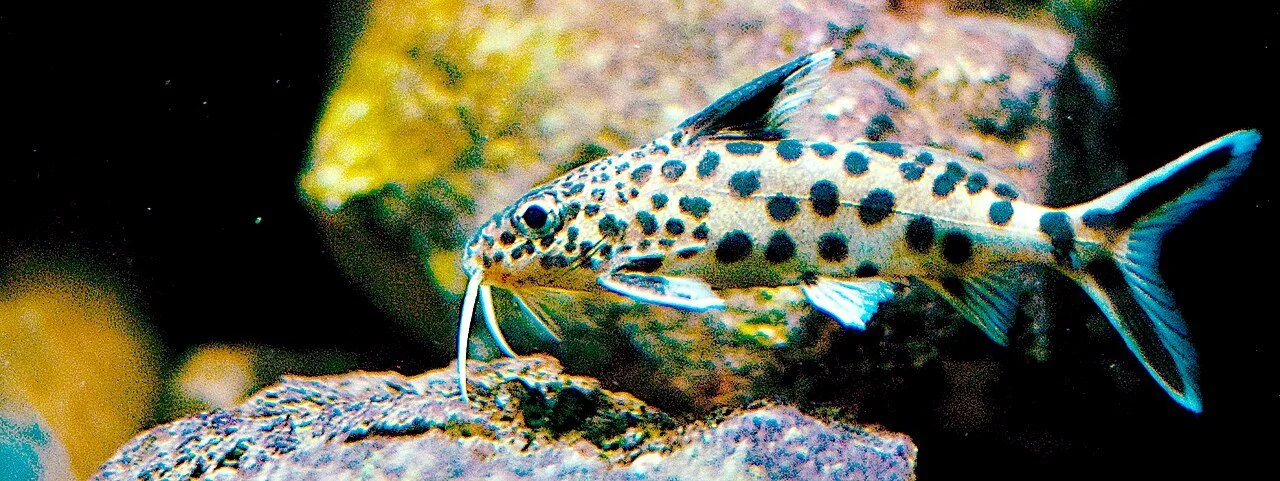 Image 1 of 1