Glass Catfish - Kryptopterus vitreolus

from £5.99

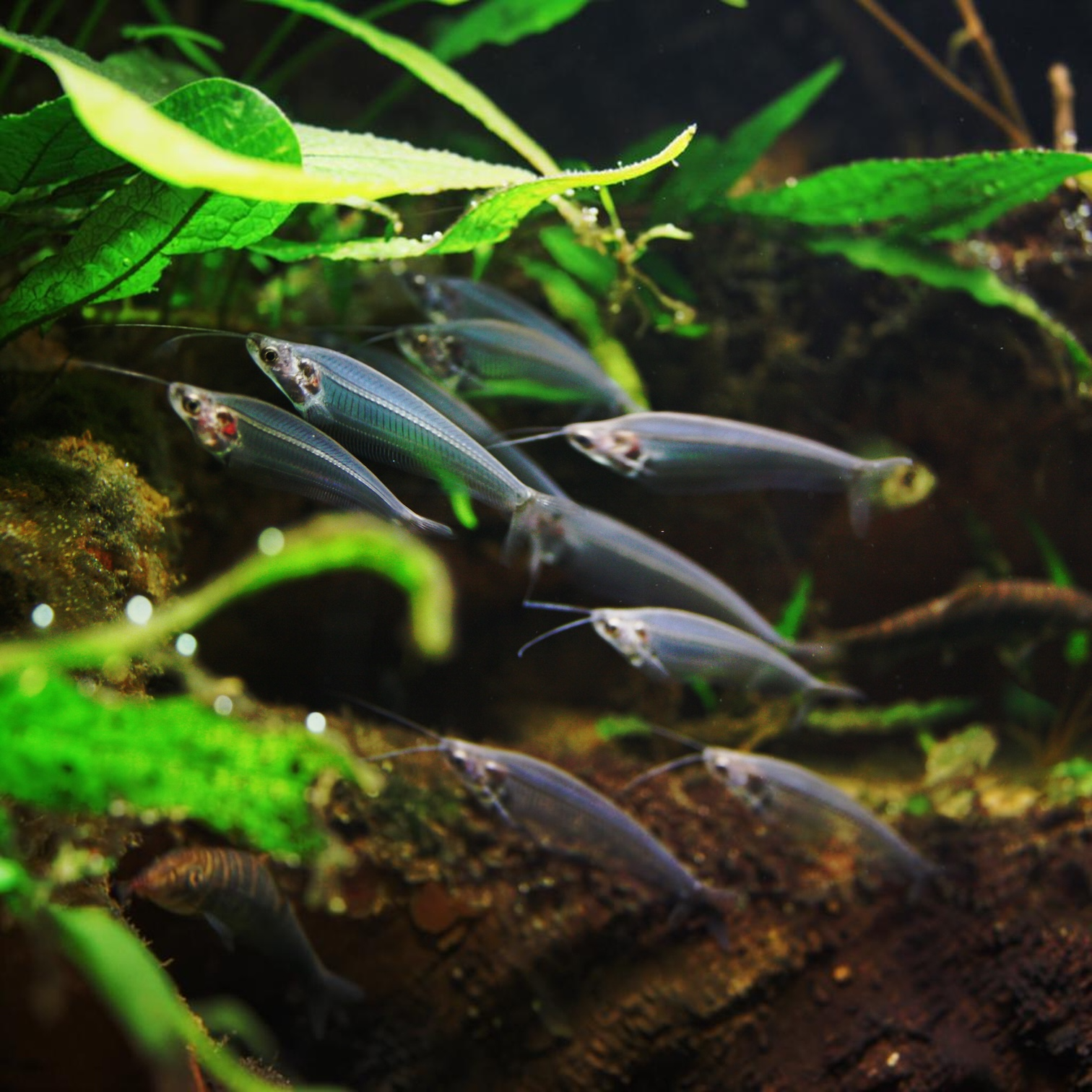
The Glass Catfish (Kryptopterus vitreolus) is one of the most unusual fish available in the hobby — its body is completely transparent, allowing you to see the skeleton, spinal cord and internal organs through the skin. A silver swim bladder sits just behind the head, and in the right light the body takes on an iridescent rainbow shimmer. When stressed or unwell the tissues turn milky white, which makes a useful early warning sign of water-quality problems.

Glass Catfish are endemic to Thailand, where they inhabit slow-moving and standing waters south of the Isthmus of Kra, in rivers draining into the Gulf of Thailand and in basins of the Cardamom Mountains. Unlike most catfish they are mid-water shoalers and rarely come down to the substrate .

They are peaceful but timid and easily outcompeted for food, so tankmates must be chosen with care. Most importantly they are highly gregarious and must be kept in a group of at least six — a single or paired Glass Catfish will become stressed, stop feeding and waste away

Merits

  • Completely transparent body — you can see the skeleton, organs and even the heart beating with a magnifying glass

  • Peaceful and safe with plants; will not uproot or nibble foliage

  • Fascinating mid-water shoaling behaviour when kept in numbers

  • Low waste output for their size

  • Iridescent rainbow effect in angled light adds extra visual interest

Diet

A carnivore by nature. In the wild they feed on small invertebrates and zooplankton . In the aquarium they do best on daily offerings of small live and frozen foods such as daphnia, Artemia nauplii (baby brine shrimp), bloodworms, grindal worms and microworms +1. Many specimens refuse dried food altogether, though some can be weaned onto suitable-sized flakes or micro-pellets — placing food near a gentle current helps trigger a feeding response . A varied diet is important; dry food alone, if accepted at all, should never be the sole food source.

Qty:

The Glass Catfish (Kryptopterus vitreolus) is one of the most unusual fish available in the hobby — its body is completely transparent, allowing you to see the skeleton, spinal cord and internal organs through the skin. A silver swim bladder sits just behind the head, and in the right light the body takes on an iridescent rainbow shimmer. When stressed or unwell the tissues turn milky white, which makes a useful early warning sign of water-quality problems.

Glass Catfish are endemic to Thailand, where they inhabit slow-moving and standing waters south of the Isthmus of Kra, in rivers draining into the Gulf of Thailand and in basins of the Cardamom Mountains. Unlike most catfish they are mid-water shoalers and rarely come down to the substrate .

They are peaceful but timid and easily outcompeted for food, so tankmates must be chosen with care. Most importantly they are highly gregarious and must be kept in a group of at least six — a single or paired Glass Catfish will become stressed, stop feeding and waste away

Merits

  • Completely transparent body — you can see the skeleton, organs and even the heart beating with a magnifying glass

  • Peaceful and safe with plants; will not uproot or nibble foliage

  • Fascinating mid-water shoaling behaviour when kept in numbers

  • Low waste output for their size

  • Iridescent rainbow effect in angled light adds extra visual interest

Diet

A carnivore by nature. In the wild they feed on small invertebrates and zooplankton . In the aquarium they do best on daily offerings of small live and frozen foods such as daphnia, Artemia nauplii (baby brine shrimp), bloodworms, grindal worms and microworms +1. Many specimens refuse dried food altogether, though some can be weaned onto suitable-sized flakes or micro-pellets — placing food near a gentle current helps trigger a feeding response . A varied diet is important; dry food alone, if accepted at all, should never be the sole food source.

Scientific name: Kryptopterus vitreolus

Common names: Glass Catfish, Ghost Catfish, Phantom Catfish, Ghost Glass Cat

Family: Siluridae Origin: Thailand (rivers south of the Isthmus of Kra, Gulf of Thailand drainages, Cardamom Mountains)

Adult size: 6–8 cm (2.4–3.1 in) Lifespan: 5–8 years

Temperature: 22–26 °C (72–79 °F)

pH: 6.0–7.5 Hardness: 2–15 dGH

Minimum tank size: 100–115 litres (for a group of 6+)

Temperament: Peaceful, timid, gregarious

Care level: Intermediate

Diet: Carnivore — live and frozen foods preferred

Swimming level: Mid-water

Minimum group size: 6

Conservation status: Least Concern (IUCN)

Fish Recommended

Other Glass Catfish (the most important — they must have their own kind), Harlequin Rasbora (Trigonostigma heteromorpha and T. espei), Emerald Eye Rasbora (Brevibora dorsiocellata), Kuhli Loach and other Pangio species, Small peaceful Corydoras (e.g. Sterba's Cory, Bronze Cory), Ember Tetra, Neon Tetra and other small calm tetras, Otocinclus and small peaceful plecos, Cherry Barb and other mild-mannered barbs, Amano Shrimp and Bamboo Shrimp (adults only — may eat very small shrimplets)

Fish to Avoid

Large or boisterous fish that will outcompete them for food, Aggressive or territorial species (e.g. most cichlids), Large predatory fish that may swallow them whole, Fin-nipping species (e.g. Tiger Barbs, Serpae Tetras), Fast greedy feeders that will reach the food first, Keeping them singly or in pairs — they need a group of 6+